Back in the Club
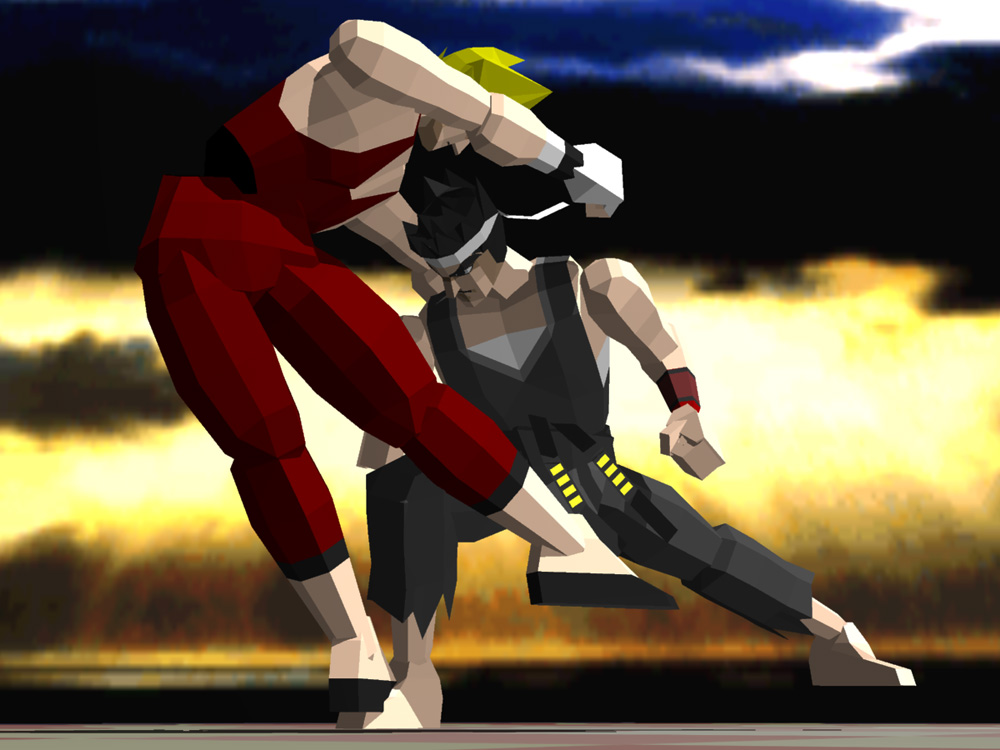
Club Sega has been updated for the first time in almost 17 years. Check out the secrets of the original Virtua Fighter and its development!
Club Sega has been updated for the first time in probably 17 years! A few happenings collided to make it happen: I started to dive into the Neo Geo library (what?), which eventually circled back to playing a fighting game series I understand (Virtua Fighter). Of course, Virtua Fighter Crossroads (VF6) has been formally announced. Oh, and add a little vacation free time to the mix.
Updates:
Club Sega – News on main page
Club Sega – Virtua Fighter – Character origins and unused characters
Club Sega – Fighters Megamix – High-res images added.
A bit of a ramble below and the story of Club Sega at Local Ditch Gaming:
Local Ditch Gaming has always had a Sega section. In addition to loving the Mechwarrior 2 related games, I had a Saturn. The weird thing about having a Saturn as kid is that it felt you’d picked a team and that you needed to root for your team, even if said team had no chance to win. I remember a sister-site on Geocities called “S.O.S. – Save our Sega!” if that gives any indication to what was happening. It makes a lot of sense: As a kid, you’ve got limited money and resources. So, picking the right console meant having good games available for the next few years. Since you’ve got way more time than money, you spend a lot of time learning the games, soaking them up, enjoying them, etc. before another birthday comes around and you get a chance at another game. I guess my point is that it all seemed to matter more. (As an adult… if you’re really into gaming, buy all of the systems you can afford, right?)
Though my gaming history started with DOS-based computers, I had a Genesis prior to the Saturn. That was my first real console. My friends also had the Genesis, so we did the standard kid stuff: swapped games, played a bunch of Sonic, argued about who was better, made up accomplishments, and somehow enjoyed it. Then… the 32X came out. I had one. Just for the record: I don’t regret it; I just wished I’d waited a few more months before getting it because Toys R Us clearanced that shit hard. I think a friend picked one up for just $20 when they were blowing them out. I digress…
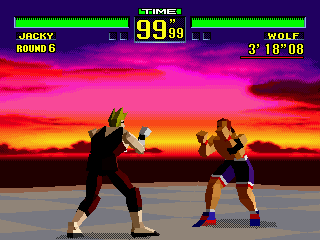
Jacky fights Wolf in Virtua Fighter on the Sega 32X
The 32X was my introduction to Virtua Fighter. Even blockier than the arcade, the 32X version played rather well. I sucked. Badly. To be fair, I sucked at most games as a kid, but hadn’t realized how bad it was yet. Fair enough, I suppose. Generally, I’d get through a few levels, then get in the “I can’t pass this stage” and tried every character ad nauseam until I got lucky. My general strategy was to find what seemed to be the most damaging move or preset combo and just spam the crap out of it. Sarah was my girl and exclusively PPPK was my strategy.
So naturally, being a dumb kid, I didn’t learn any lessons from Sega abandoning the 32X, though I learned to love Virtua Fighter and eventually ended up grabbing a Saturn. Virtua Fighter 2 was freaking awesome. I still largely sucked, but actually started to learn the game a bit more. (At this point in life, I’d say I’m competent in VF. Not quite “good,” but I understand what happens, why it happens, what I should do, and how the systems work.)
Of course, the Saturn eventually gave way. Rather than hopping onto the Playstation train, I marched over to the Dreamcast. That being said, I never regretted owning a Saturn. The Dreamcast was awesome. The games on the Dreamcast were awesome. The internet connectivity was awesome. I feel like this is where Sega finally got it right after straying from the success of the Genesis. But alas, there wasn’t enough money in the Sega bank to outlast the onslaught of the Playstation 2. At this point, I had finished high school and gone off to college where I pretty much stopped following games and working on the Local Ditch. I think the first large gap of no updates was around this time. (Sorry for all of the Battlezone players that contacted me in the early 2000s drought. I did eventually respond to everyone, even if years later.)
So, mid 2000s: I’m out of college, have a little bit of pocket change now, and decide the best use of my free time (How did it feel like I had so much time then?) was to break out my old Saturn, catch up on all the games I missed out on, work through all of the games I had, then review them at the same time. Of course that’s all good and fun, and the more I play a game, the more I like to dig into it, its history, and the info about it. So, I have to document the cool things I’d find while doing that, too. This is when the Sega portion of Local Ditch Gaming became Club Sega.

Logo for the Club Sega blog
At the same time, I was interested in blogging. And, I had finally made a sensible choice in gaming consoles and picked up a Playstation 2. So, the plan was to run more “blog-like” content at clubsega.blogspot.com (Yeah, that’s me, too.) and keep the longer reviews and game “wiki” here. (Wiki in quotes as the Club Sega site actually looked quite like Wikipedia before Wikipedia existed. In fact, the site’s layout was mostly inspired by how amazing Sonic fan site The GHZ is/was.)
Of course, my general focus on the website and the realities of adult life can only last so long. At some point, I stopped going through the old Saturn games and updating the site for no real reason other than there was work to do, other hobbies, and other major life events underway.
At some point later, the consoles eventually migrated into storage. I become super interested in emulation and decided that rather than dig my consoles out when I wanted to play, I’d just emulate everything from a flash disk. So, I’d ripped all of my Saturn, Dreamcast, and PS2 games manually, then set up a front end using Emulation Station to run my particular emus of choice. (About a decade later, I’d eventually sell all of my physical games and consoles, barring an XBOX 360.) It worked well enough for me…
…for a while. I’d always told myself if I were to ever get an arcade cab, it would be for Virtua Fighter 2. That was the arcade game for me. Around the Club Sega era, I had looked into tracking one down, but it made absolutely no damn sense. So, I never went through with it. Emulation got better, cheaper, more affordable. It seems like a lot of it had moved off of the PC and into the Raspberry Pie world, which also caught my attention.
Sometime around 2020, I finally pulled the trigger. A local MicroCenter had a three-quarter-scale arcade-cabinet frame, basically the cabinet equivalent of IKEA shelving. I repurposed an old mini-gaming computer from my partner, and with a lot of customization and the approach of “lets do things the hard way,” I built a PC-based emulation arcade cab. One of my big hangups before pulling the trigger was “Would I actually play this thing?” As it turns out, yes. In fact, way more than I thought I would. (I had the same experience with buying a grill, oddly enough.)

Though the original plan was to do a Virtua Fighter theme on the cab, I ended up loving how this Daytona USA artwork fit.
I started loading the arcade cab mid-90s early 3D Sega games. I already owned copies of those on a lot of systems, but now, I could finally run and play the exact arcade version. ElSemi’s Model 2 emulator was golden. In some sense, I finally had my Virtua Fighter 2 cab, but without all of the negatives: eating up physical space, being as power-hungry, or dealing with as much maintenance and labor that a real cab required. A not-so-needed rule was that I’d only put proper arcade games on the thing. There were a couple of lingering Genesis games back from when this essentially started as a flash disk, but otherwise, arcade only — no quarters required, then it doesn’t belong in it.
Though I thought VF2 was my game, there was a real winner: Virtual On: Oratorio Tangram 5.4. I ended up swapping the standard levers for twinsticks in the cab and playing VOOT is sublime.
At some point, I wanted to experience the classic Street Fighter and related games. Back in the day, the Mortal Kombat series was my 2D fighter of choice and I missed out on the Super Street Fighter II Turbo, Darkstalkers, Gem Fighters, Mavel vs. Capcom, etc. of the time. I will say it was a major learning curve getting used to holding back to block.
Well, that eventually led to curiosity about a series with shared history: the classic SNK fighters. Originally, SNK poached several members of the team that created the original Street Fighter. In some sense, Art of Fighting was an alternative approach as a Street Fighter sequel. Eventually, this led to me track down a NEO GEO mini… which to just emulating the games and playing on the arcade cab.
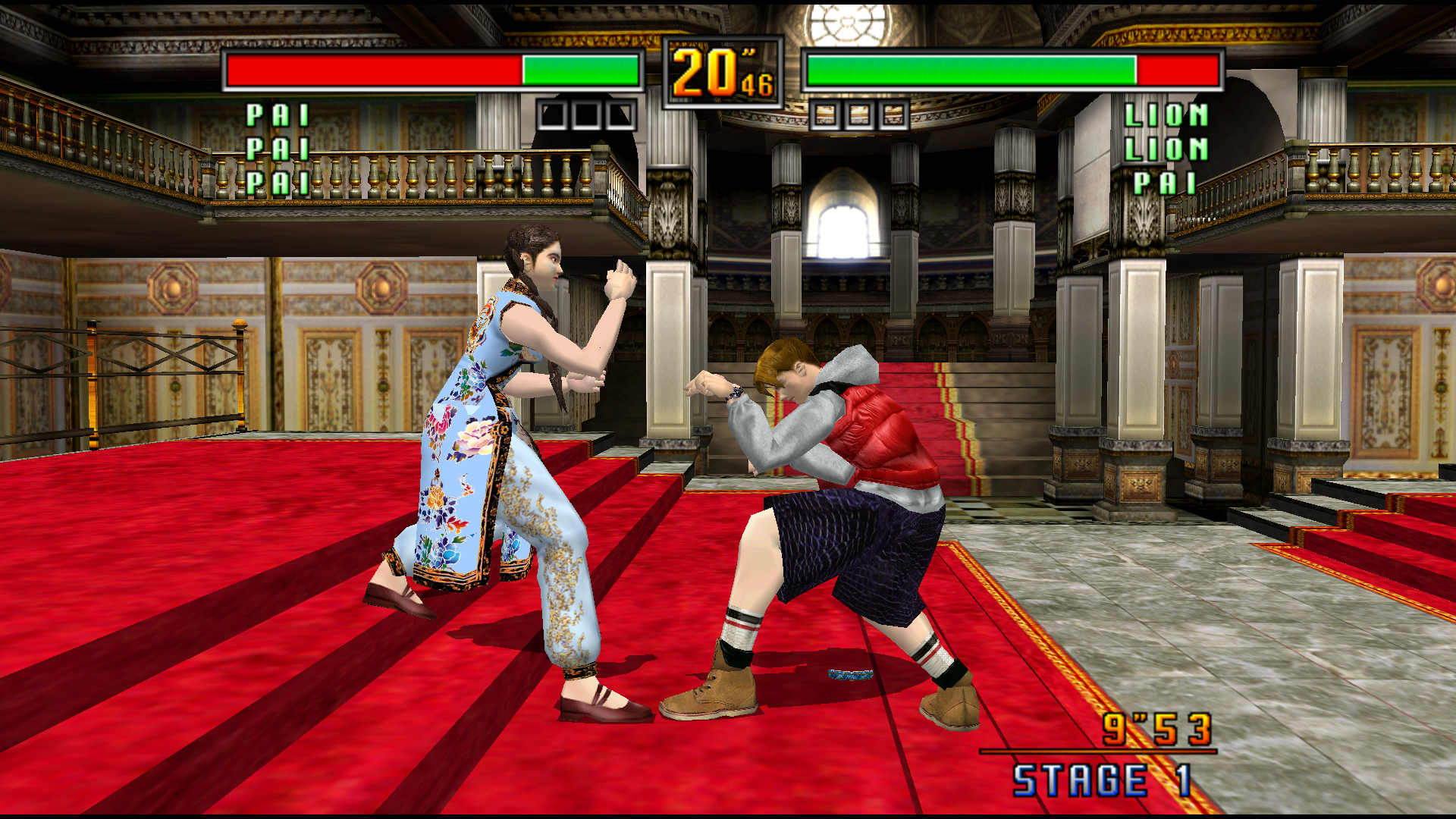
Pai and Leon battle in Virtua Fighter 3
And… to the point of all of this. Which kind of led me back into playing Virtua Fighter. In some sense, stepping into a familiar game is kind of like coming home; things just work how you expect and know them to. VF1 didn’t really click with me any more, maybe the sheer rawness is too hard to embrace. VF2 is still awesome, though it’s mostly me playing against the AI with all of its wickedness and quirks. VF4 and VF5 are cool and almost too smooth. And then there’s Virtua Fighter 3.
It was a big deal in 1996. The graphics were insane at the time. It’s definitely one of those “you had to be there” moments to understand how crazy of a jump it was. Characters eyes tracked the screen. Dresses flowed. Sand bounced off the ground. Muscles flexed! But somehow… it just feels a little off today. Graphically, it obviously doesn’t have the same impact. I think the bigger issue is with the cartoonish character designs as they almost seem uncanny. Lion looks like he’s ready for the Tour de France. Kage’s alt outfit has a mesh top and silver reflective pants… on a ninja? That being said, the addition of the dodge button made it incredibly easy to move around opponents, though elevation changes in the stages definitely caused some imbalance.
Playing the oddball game has my interest, so I’ve been working on VF3 a lot recently. Which coincidentally, lined up right to when Virtua Fighter Crossroads was announced. So. long story short, expect more updates to the Virtua Fighter pages in Club Sega. Some of this stuff has been on the to-do list forever, like the character influences. Some of it’s relatively new info, like the hidden characters in the game code. Some are high-res pictures that I’ve found and updated. I’ll probably not put a post on the main page for every little change, but check the dates on the bottom of the pages and expect some updates for the next while!